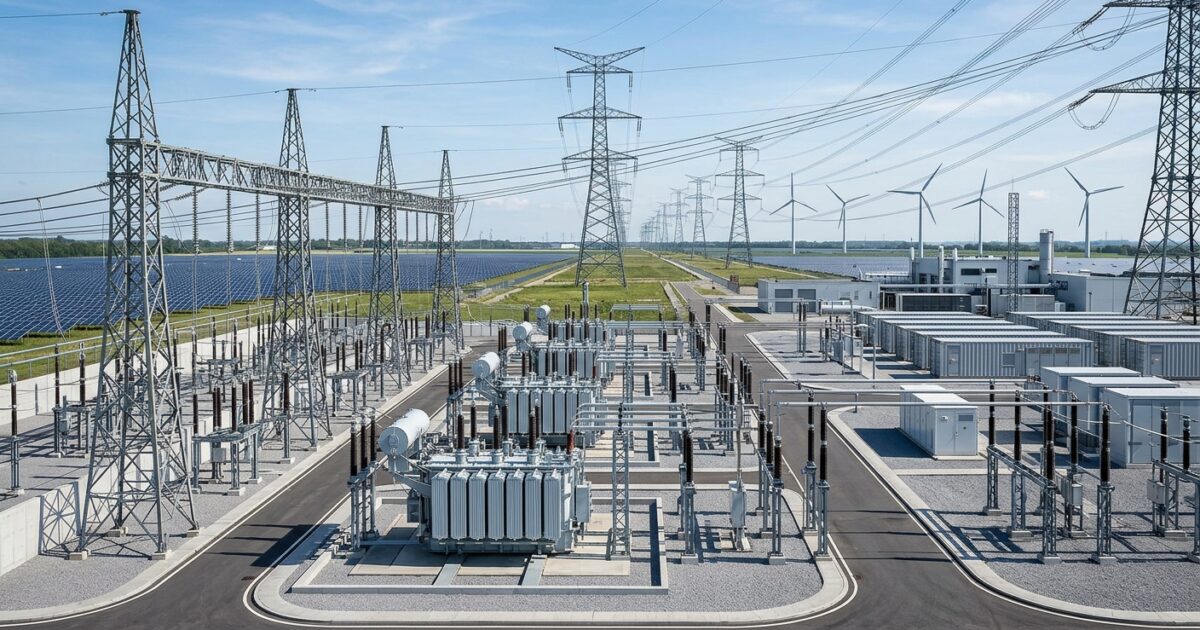
Large energy projects depend on electrical infrastructure that can deliver power safely, consistently, and efficiently throughout the facility’s operating life. Whether the project involves a power plant, renewable energy facility, industrial complex, utility-scale battery system, or major transmission network, reliable infrastructure begins with careful engineering and planning.

Modern projects are also becoming more complex. Higher power demands, renewable generation, digital controls, stricter grid requirements, and changing operational conditions all influence how electrical systems must be designed. This is where power infrastructure engineering, electrical power engineering, and energy project engineering play an important role.
A well-engineered power system does more than keep equipment running. It improves reliability, supports operational flexibility, reduces risks, and creates a foundation for long-term project performance.
1. Start With Clear Project Requirements
Reliable infrastructure starts with understanding what the project actually needs. Engineers should evaluate the facility’s expected electrical demand, generation capacity, operating conditions, critical loads, expansion plans, and connection requirements before developing the detailed design.
Load forecasting is particularly important for large facilities. Underestimating demand can create overloaded equipment and operational problems, while excessive capacity can increase capital costs without providing meaningful benefits.
Engineers typically assess:
- Present and future electrical loads
- Critical and non-critical loads
- Generation and import/export requirements
- Voltage levels and power quality
- Emergency and backup power requirements
- Equipment operating characteristics
- Future expansion opportunities
- Utility interconnection requirements
This early assessment provides the technical foundation for the rest of the project.
2. Develop a Resilient Electrical Architecture
Once project requirements are established, engineers can develop an electrical architecture capable of supporting reliable operation. The system may include generators, transformers, switchgear, substations, transmission or distribution lines, protection systems, auxiliary systems, and control equipment.
For large projects, redundancy can be an important consideration. Critical equipment may require multiple power sources or alternative supply paths so that a single equipment failure does not result in a major outage.
Electrical system configuration should also consider maintenance. A design that allows equipment to be isolated without shutting down the entire facility can significantly improve operational flexibility.
Through electrical power engineering, engineers can evaluate different configurations and select an architecture that balances reliability, safety, performance, and cost.
3. Use Power System Studies to Identify Risks
Engineering decisions should be supported by detailed technical analysis rather than assumptions. Power system studies help identify potential problems before construction and commissioning.
Common studies for large energy projects include load flow analysis, short-circuit studies, transient stability analysis, voltage stability assessments, motor starting studies, arc-flash analysis, and protection coordination studies.
Load flow analysis can reveal voltage and loading conditions under normal and contingency scenarios. Short-circuit studies help determine fault levels and support the correct selection and rating of electrical equipment.
Protection coordination is equally important. Protective devices must operate selectively so that faults can be isolated quickly while minimizing unnecessary disruption to healthy sections of the system.
These studies allow project teams to address weaknesses during the design stage, when changes are generally easier and less expensive to implement.
4. Plan for Grid Connection and Compliance
Large energy projects rarely operate independently from the wider electrical network. Grid interconnection requirements can significantly influence project design.
Depending on the project location and connection arrangement, engineers may need to evaluate voltage control, reactive power capability, frequency response, fault ride-through performance, protection requirements, power quality, and system stability.
Renewable energy projects can require additional analysis because solar and wind generation behave differently from conventional generation. Battery energy storage systems also introduce unique operating modes and control requirements.
Effective energy project engineering considers these requirements from the beginning instead of treating grid compliance as a final-stage activity. Early coordination with utilities, grid operators, and other stakeholders can reduce redesign risks and support smoother project approvals.
5. Consider Reliability, Safety, and Maintainability
Reliability is closely connected to safety and maintainability. Electrical infrastructure should be designed so that personnel can safely operate, inspect, test, and maintain equipment.
Equipment selection should consider environmental conditions, fault levels, thermal performance, insulation requirements, accessibility, and expected service life. Substation layouts, cable systems, grounding networks, switchgear arrangements, and protection systems should all work together as part of a coordinated design.
Grounding and bonding are particularly important for personnel safety and equipment protection. A properly engineered grounding system helps control touch and step voltages and provides appropriate paths for fault currents.
Maintenance requirements should also be incorporated into the design. Clear equipment access, appropriate isolation points, spare capacity, and maintainable layouts can reduce downtime over the project lifecycle.
6. Design for Future Growth and Changing Energy Needs
Large energy facilities can operate for decades, and their electrical requirements may change significantly during that period. A reliable design should therefore consider future conditions rather than focusing only on initial commissioning.
Projects may later add generation capacity, battery storage, production equipment, or additional electrical loads. Designing suitable expansion provisions during the initial project phase can make future modifications considerably easier.
Digital technologies can also improve long-term performance. Modern monitoring, automation, protection, and control systems provide operators with greater visibility into system conditions and equipment performance.
This combination of forward-looking planning and advanced engineering helps infrastructure remain useful as energy technologies and operational requirements evolve.
Building a Reliable Foundation for Long-Term Performance
Reliable power infrastructure is the result of coordinated planning, detailed analysis, appropriate equipment selection, and disciplined engineering. For large energy projects, electrical systems must perform reliably under normal operation while also responding effectively to faults, contingencies, maintenance activities, and future changes.
Professional power infrastructure engineering provides the framework for integrating generation, transmission, distribution, protection, control, and supporting systems into one dependable network. Meanwhile, electrical power engineering ensures that technical decisions are supported by rigorous analysis and practical design principles.
At Keentel Engineering, a structured engineering approach can help project owners and developers address electrical challenges early, improve system reliability, and develop infrastructure that is ready for both today’s requirements and tomorrow’s energy demands.
A strong electrical foundation ultimately supports more than reliable power—it supports safer operations, better project performance, and long-term energy infrastructure resilience.



CoCoFlix is an Android entertainment app with a clean and simple design. Its content library receives updates, so users can keep an eye on new releases and changes. I share information about the app, including its latest version, features, requirements, installation process, and other details worth knowing before using it. https://cocoflixapp.org/