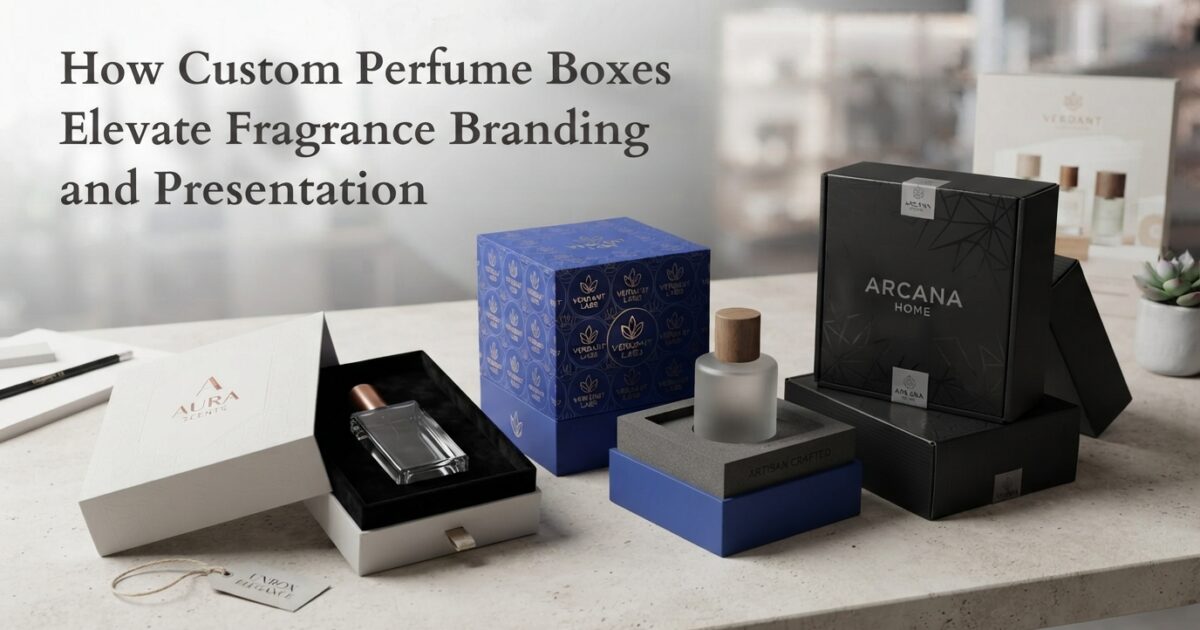
A fragrance is often purchased for more than its scent. The bottle design, brand story, visual identity, and presentation can all influence how customers perceive the product.

That makes packaging particularly important for perfume brands. Before customers spray a fragrance, they often encounter its packaging first. The box can establish expectations about the product’s personality, positioning, and quality.
For brands looking to create packaging around a specific fragrance collection or product, Custom Boxes USA can provide a foundation for developing packaging around product dimensions, branding requirements, and presentation goals.
Why Perfume Packaging Matters
Perfume bottles can have distinctive shapes, glass components, decorative caps, and delicate finishes. Packaging therefore needs to address both presentation and practical protection.
A well-planned fragrance box can help:
- Hold the bottle securely
- Present the product attractively
- Communicate brand identity
- Organize additional materials
- Support a premium unboxing experience
- Provide an appropriate outer layer for distribution
The packaging should be developed around the actual bottle rather than relying solely on a generic box size.
What Makes Perfume Packaging Different?
Perfume packaging often needs to balance several requirements simultaneously.
The bottle may be fragile, unusually shaped, or heavy relative to its size. At the same time, fragrance brands frequently place considerable emphasis on visual presentation.
This creates a packaging challenge: the box needs to look appealing while also providing a suitable structure for the product.
Dimensions, inserts, materials, printing, closure style, and finishing can all influence the final result.
Designing the Box Around the Bottle
One of the first steps in creating custom perfume boxes is understanding the product’s exact dimensions.
Brands should account for:
- Bottle length
- Bottle width
- Bottle height
- Cap dimensions
- Bottle weight
- Number of products
- Additional components
- Insert requirements
A properly sized package can create a cleaner presentation and help prevent unnecessary movement inside the box.
If a fragrance collection contains several bottle sizes, the packaging strategy may need to accommodate each configuration separately.
Using Inserts for Protection
An insert can provide an important layer of organization inside a perfume package.
Rather than allowing a bottle to move around inside an empty box, a fitted insert can create a designated space for the fragrance.
Depending on the product and desired presentation, brands may consider materials such as:
- Foam
- Paperboard
- Cardboard
- Custom trays
The appropriate material depends on the bottle, required support, presentation objectives, and packaging specifications.
Inserts can also printed rigid boxes accommodate additional components such as fragrance samples, information cards, or promotional materials.
Creating a Premium Unboxing Experience
Perfume is strongly associated with luxury, personal expression, and sensory experiences. Packaging can help extend those qualities into the physical opening experience.
A carefully planned box can create a sequence in which the customer encounters the brand before seeing the fragrance bottle.
For example:
Exterior branding → opening mechanism → interior artwork → product reveal → supporting materials
Each stage can be designed to feel consistent with the fragrance’s identity.
A minimalist fragrance may benefit from restrained packaging, while a bold or theatrical scent could use stronger graphics and more dramatic presentation elements.
Printing and Branding
Packaging provides perfume brands with a large surface for communicating their identity.
Design elements may include:
- Logo
- Fragrance name
- Collection name
- Typography
- Brand colors
- Patterns
- Illustrations
- Product information
Interior printing can also be used to continue the visual story after the box is opened.
Consistency is important. The packaging should feel connected to the bottle, website, advertising, retail displays, and other brand assets.
Finishing Options for Fragrance Packaging
Special finishes can help emphasize selected elements of a perfume package.
Depending on the project, brands may consider:
Foil
Foil can highlight a logo, fragrance name, or other important details.
Embossing
Embossing adds raised physical detail to selected areas of the packaging.
Debossing
Debossing creates a recessed impression that can add texture and visual depth.
Soft-Touch Finish
A soft-touch surface can provide a smoother tactile experience and complement premium visual designs.
Matte or Gloss
Matte and gloss finishes can create different visual effects and can be selected according to the desired brand aesthetic.
Spot UV
Spot UV can create selective glossy areas that contrast with the surrounding surface.
These finishes are best used strategically. A sophisticated package does not necessarily need every available finishing technique.
Perfume Boxes and Brand Positioning
Packaging can help communicate where a fragrance sits in the market.
A premium perfume may use a structured box, restrained typography, and carefully selected finishing details. A youthful fragrance collection might use colorful artwork and energetic graphics.
The packaging should match the intended audience.
This is particularly important when a fragrance brand has several product lines. Distinct packaging systems can help customers differentiate collections while maintaining a recognizable overall brand identity.
Packaging for Perfume Gift Sets
Fragrance is frequently purchased as a gift, making presentation especially important.
A gift set may contain:
- Perfume bottle
- Travel-size fragrance
- Body lotion
- Samples
- Promotional materials
- Information cards
A custom interior can give each item a designated position.
The box structure should account for the combined dimensions and weight of the complete set rather than only the main perfume bottle.
Packaging for Multiple Bottle Sizes
Perfume brands may offer several bottle sizes, such as travel, standard, and larger formats.
Each size can create different packaging requirements.
Smaller bottles may need compact inserts to prevent movement, while larger bottles may require more substantial internal support.
For brands offering multiple sizes, developing a consistent visual system across different box dimensions can help maintain brand recognition while ensuring each package fits its product appropriately.
Considering Shipping and Distribution
Perfume packaging should be considered in the context of its distribution method.
Products may move through warehouses, fulfillment centers, retail environments, and shipping networks before reaching the customer.
The packaging therefore needs to be appropriate for the expected handling conditions.
A presentation box may work alongside additional protective shipping packaging when required. The exact approach depends on the product, distribution method, and shipping environment.
Testing can also help brands identify potential issues before a larger production run.
Sustainability in Fragrance Packaging
Sustainability is increasingly relevant to packaging decisions across the fragrance industry.
Brands can consider:
- Material selection
- Box dimensions
- Recyclability
- Excess packaging
- Reusability
- Insert materials
Right-sizing the package can help avoid unnecessary empty space. Selecting appropriate recyclable materials where available can also support a brand’s broader packaging goals.
At the same time, sustainability decisions should not compromise the packaging’s ability to protect a fragile fragrance bottle.
Perfume Packaging for Ecommerce
Online fragrance sales remove the physical retail shelf from much of the purchasing process.
Instead, customers may encounter the product first through digital photography, advertising, or social media before receiving the physical package.
This makes the delivery experience an important opportunity to connect digital branding with the physical product.
A carefully designed package can help maintain the same visual identity customers encountered online.
The box may also become part of social media content when customers share purchases or unboxing experiences.
Common Perfume Packaging Mistakes
Using an Incorrect Box Size
A box that is too large can leave excessive empty space, while one that is too small may make the product difficult to pack.
Forgetting the Bottle Cap
The cap should be included when determining the complete packaged height and interior clearance.
Ignoring Fragility
Glass bottles require appropriate consideration during packaging design and shipping.
Overloading the Design
Too many colors, fonts, or finishes can weaken the visual hierarchy.
Neglecting the Interior
The customer sees the interior during the most important stage of the unboxing experience.
Failing to Consider Shipping
Packaging should be developed with the actual distribution process in mind rather than evaluated only in a showroom environment.
How to Plan a Perfume Box
A structured planning process can make packaging development more efficient.
1. Measure the fragrance bottle.
Record the complete dimensions, including the cap.
2. Determine the product configuration.
Identify whether the package will hold one bottle, multiple bottles, or a gift set.
3. Establish protection requirements.
Consider fragility, weight, and expected shipping conditions.
4. Select the structure.
Choose a box style appropriate for the product and desired opening experience.
5. Plan the insert.
Determine whether foam, paperboard, cardboard, or another solution is appropriate.
6. Develop the artwork.
Align the packaging design with the fragrance’s brand identity.
7. Select finishing details.
Choose finishes that support the desired aesthetic.
8. Review the complete package.
Consider packing, storage, fulfillment, shipping, and customer opening experience.
9. Evaluate a sample where appropriate.
A prototype can help reveal dimensional, structural, and presentation issues before production.
Frequently Asked Questions
1. Why are custom perfume boxes important?
Custom perfume packaging allows brands to create a box around the fragrance bottle while incorporating branding, protection, inserts, and presentation requirements.
2. Can perfume boxes include custom inserts?
Yes. Inserts can be designed to hold fragrance bottles securely and organize additional products or promotional materials.
3. What finishes can be used for perfume packaging?
Depending on the packaging specification, brands can consider matte, gloss, soft-touch, foil, embossing, debossing, and Spot UV finishes.
4. Can perfume packaging be designed for gift sets?
Yes. The box and interior can be planned around multiple products, such as fragrance bottles, travel sprays, samples, lotions, and information cards.
5. How should brands choose the right perfume box size?
The package should be based on the complete product dimensions, including the bottle and cap, along with any inserts, accessories, and protective requirements.
Conclusion
Perfume packaging is an opportunity to combine product protection with brand storytelling. The right box can support a fragile fragrance bottle while also creating a memorable first impression and a more considered unboxing experience.
From dimensions and inserts to printing and finishing, every part of the package can be aligned with the fragrance’s identity.
For brands selling through ecommerce, retail, gifting, or promotional campaigns, packaging can become an important physical connection between the customer and the fragrance brand.
The strongest approach is to begin with the product, understand its protection requirements, and then build the visual and structural experience around it. When those elements work together, perfume packaging can support both practical distribution and premium brand presentation.